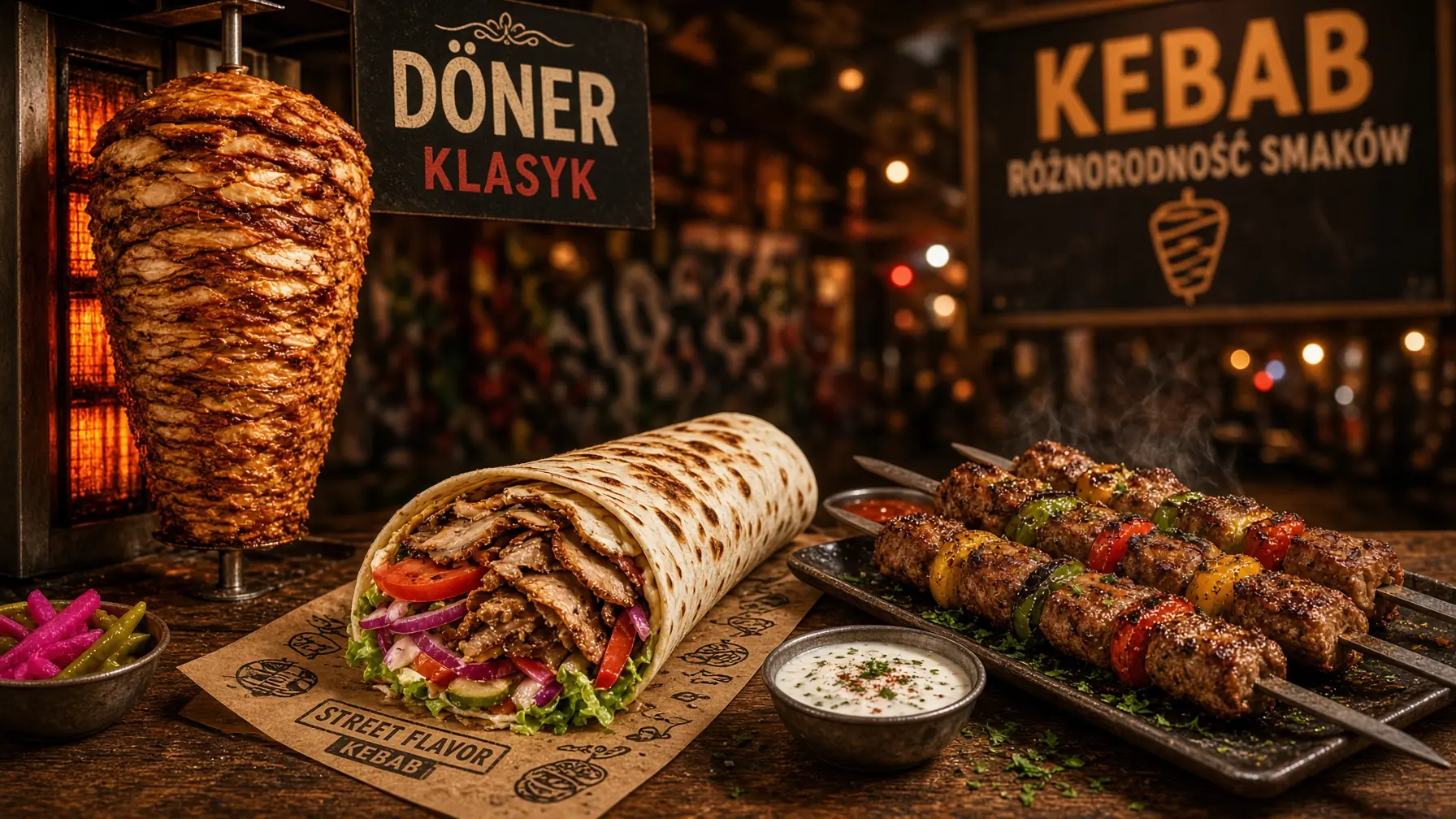
What is kebab?
Döner is just the beginning. The word "kebab" covers dozens of varieties — from Turkish shish kebab (meat on skewers) to Lebanese lamb kebab and a whole family of flavours. In Poland the street-food version dominates: flatbread or tortilla with meat, lettuce, tomato and garlic or chilli sauce.
Where does kebab come from and who invented it?
The modern history of döner kebab is shaped by two figures. Iskender Usta from Bursa in the 19th century invented the vertical rotisserie — and döner was born. A century later, Kadir Nurman, a Turkish immigrant in Berlin, wrapped the meat in a bread roll with salad — creating the street-food format that conquered Europe. Today Berlin alone has over 1,500 döner spots.
What are the types of kebab?
| Type | Meat & preparation | How to recognise it |
|---|---|---|
| Döner | Layered meat on a vertical rotisserie, carved into slices | Rotating cone by the counter |
| Shish kebab | Chunks of meat on skewers, grilled | Metal skewers, cubed meat |
| Dürüm | Döner tightly rolled in thin flatbread (not tortilla) | Compact roll, no filling visible |
| Adana | Spiced minced meat on a wide flat skewer | Elongated shape, intense flavour |
| Iskender | Döner on pide bread with tomato sauce and yoghurt | Served on a plate, never to-go |
| Yaprak | Hand-carved thin slices — no machine | Irregular, thinner slices, juicier |
According to Pyszne.pl 2026 data, flatbread (lawasz) accounts for around 25% of all kebab orders — the most popular format for the second year running.
Kebab in Poland — by the numbers
2026 trend: craft kebab. Pyszne.pl forecasts a 43% rise in premium kebab orders — consumers increasingly choose meat quality and house-made sauces over the lowest price. The number of kebab spots on Pyszne.pl alone grew 30% in three years to over 3,300.
Where do Poles eat the most kebab per capita? Not Warsaw — the podium goes to Kołobrzeg, Luboń and Pszów. Among cities over 100k, Gorzów Wielkopolski, Rzeszów and Zielona Góra lead the way.
How much does kebab cost in Poland?
Kebab is still the cheapest fast food in Poland. For comparison: the average burger costs 37.61 PLN and pizza 51.39 PLN (dlahandlu.pl). This is one reason kebab holds its position as the top online food order.
Where is the best kebab in Poland?
The ranking updates every week, so a new star doesn't wait months for recognition. No place pays for its position — the data is fully algorithmic. Check the current top in your city:
How to find a good kebab nearby?
Radar considers review sentiment, not just star count. A place with 4.3 stars and genuinely positive reviews can rank higher than one with 4.8 built on 20 generic five-star reviews.
Kebab or kebap — which is correct?
In Polish the word declines as: kebab, kebaba, kebabem — not "kebab'a". The form "kebap" shows up mainly in contexts stressing Turkish authenticity, e.g. on shop signs.
Looking for a kebab today?
Pick your city and check which place is at the top — KebabRank's ranking updates every week based on AI analysis of real Google Maps reviews.
Data: KebabRank AI · sentiment analysis of Google Maps reviews from 2,300+ places in 69 cities · updated weekly.
Author: KebabRank — kebab ranking platform for Poland since 2024.